



Author: dblauadmin
October 5, 2012 – November 3, 2012
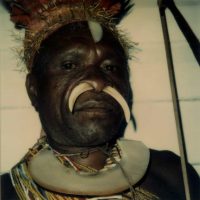
“In ’74 I photographed the cannibals in New Guinea. They treated me OK but they didn’t make you feel relaxed…I managed to escape unscathed though, I’m pretty good at that.”
A visit to Bailey’s studio. A treasure! A box of Polaroids from 1974.
When visiting an artist as versatile as Bailey, one should always expect the unexpected. Despite this, it was a great surprise to discover a box of Polaroids taken in Papua New Guinea in 1974, fascinating for their subject matter as well as for their artistic merit.
What followed was a happy-dance and a handshake confirming the opening of “Papua Polaroids” on October 4th.
In 1974 David Bailey visited the New Guinea wilderness and pointed his Polaroid camera at the bow and arrow carrying people, resulting in photographic portraits that have been hidden from view in his archive ever since.
Today indigenous peoples are gazed at and possibly even envied by us for the seemingly simpler and more understandable world they inhabit. The nostalgic aura of Polaroid film intensifies this sense of longing for a more natural and primal way of life.
Daniel has long been interested in Oceanic Art. It is therefore a particular pleasure to find this interest mirrored in Bailey’s work of the 70s.
October 11, 2012 — October 14, 2012
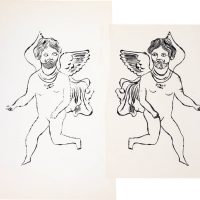
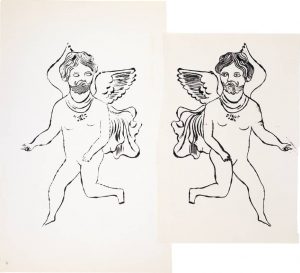
For the inaugural Frieze Masters art fair in London we will be showing the third part of our exhibition trilogy “From Silverpoint to Silver Screen”, a special one-man exhibition of Andy Warhol drawings from the 1950s.
These outstanding drawings are from the personal collection of one of the 20th century’s most significant artists, presented to the public for the first time, 50 years after their creation. We are afforded a unique and comprehensive insight into Andy Warhol’s work in the 10 years following his departure from the grey city of Pittsburgh, during the period of his artistic emancipation in New York. This is an opportunity to get to know him as the grand draftsman that he was.
Excerpt from the catalogue text by Sydney Picasso:
…
And his thirst bore him through, every image was seized, and while moments of repose produced slow and steady line drawings, time passing drove him to tracing, blotting, repro, collage; in this series we observe an impressive roster of techniques. The theme is not idleness, it is haste, an irrepressible drive to get on with it, to record and thus “live” this new life he has embraced, which will turn out to be tragically short. His “Walk on the Wild Side”: thirty odd years of total immersion, and I believe revelry, in a world he had only glimpsed before arriving on the streets of New York. “I was nobody, I came from nowhere,” he repeated. And as he was willing to literally try anything, we witness here such odd subjects as children in groups, facial studies, and the infamous child shooting up “America’s nightmare,” a mercenary drawing for a CBS series of recordings based on childhood addiction: Andy won the “prize” for art direction for this project and the image became iconified in what would become the first of his many record covers. This initiated yet another chapter in his endless forays into media, to the point that certain later images would portray the Daily News heading directly incorporated in the painting, such as in Daily News, 1962, portraying Eddie Fisher and Liz Taylor’s breakup.
Special Preview: 9 Oct, 3 – 8 pm
Professional View: 10 Oct, 11 am – 7 pm
Exhibition: 11 – 13 Oct, 12 – 7 pm
14 Oct, 12 – 6 pm
Regent’s Park, London
Booth F13
September 14, 2012 – October 19, 2012
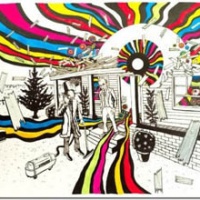
These recent drawings combine Neal Fox’s visionary depictions of the debauched and iconoclastic characters whose ideas have helped shape our collective consciousness with vivid colours that enhance the fantastical and psychedelic atmosphere of the images. Drawing on his extensive knowledge of the mythology of pop and consumer culture, Fox’s new drawings are infused with layers of narrative and populated by a vast range of celebrities, lunatics, and geniuses.
In these imagined landscapes Captain Beefheart sells a vacuum cleaner to Aldous Huxley at the Doors of Perception, while elsewhere Jesus is crucified on a McDonald’s sign and popular culture comes to resemble a neon nightmare. We present an exhibition of re-imagined reality and collaged dreams, the familiar made unfamiliar and strange.
September 20, 2012 — September 23, 2012
For our first exhibition at Expo Chicago we are pleased to offer an overview of our extensive collection in the form of a selection of works on paper from 1950 – 1980. Our mixed booth is a representation of the gallery’s program, and all works hail from past and future exhibitions.
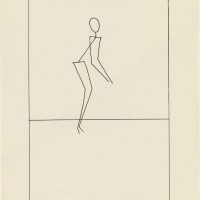
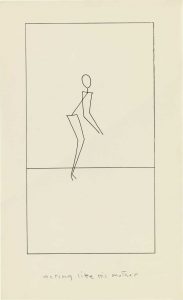
We present a varied taste of the art that came out of the mid-to-late twentieth century. Gathered here is a diverse juxposition of black and white photos, including a number of NASA prints, works by German artists such as Georg Baselitz, Matt Mullican’s stick figures, and to complement our upcoming London exhibition of David Bailey’s Papua New Guinea polaroids, we will have on show a number of his Planet of the Apes polaroids.
Please join us for our opening at Booth 503 on 19th September from 3 – 9 pm.
September 7, 2012 – September 29, 2012
“There shall be wings! If the accomplishment be not for me, ‘tis for some other. The spirit cannot die; and man, who shall know all and shall have wings…”
Leonardo da Vinci
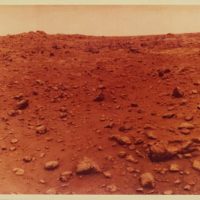
Daniel Blau presents an extraordinary exhibition of rare NASA photographs and photographic collages of Mars. The collages are composed of vintage silver gelatin prints and are unique works of art.
Until the Mariner 4 probe’s successful fly-by in July 1965, Mars had only been seen through terrestrial telescopes. All of a sudden photographs were transmitted to earth that were of such clarity that we could almost touch the surface of the planet. Viking 1 continued where the Mariner missions left off, and delivered wonderfully detailed photographs of this mysterious planet, named after the Roman God of War and long subject to speculations regarding the possibility of alien life.
What began as a race to put a man on the moon progressed further and further into space, spurred on by limitless ambition and curiosity. These photographs evoke an incomparable time in history when technology was developing at an incredible rate and the impossible became not only possible, but visible for the entire world to see.
June 12, 2012 — June 17, 2012
And as Warhol was a man of few words, his drawings speak: in praise and eloquence of his world, the gaudy rush of images he must have assimilated, arriving in New York from the dark and smoky depths of Pittsburgh. And what results is reactive, he just cannot draw enough. He observes, records and stages – much in the way he dresses windows, the ongoing play of life and its actors. And until he grasps the Polaroid – another direct tool of observation, the hand and the pencil work ceaselessly. And the mass of images produced by 50s and 60s glossy magazines streams by. The weeklies became a window to the world and its frenzy. As Weegee and others constantly pounded the streets at night, a whole new universe and dramatis personae emerged. High society collided with street life, and the inner workings of the big city emerged on shiny sheets, the flash bulb catching its subjects, their eyes pinned in surprise, as an animal caught in the headlights of an oncoming vehicle. This is the locale, Andy’s motif where day and night were inseparable landscapes, and endless fodder for his eager hands…
Quote from the catalogue essay by Sydney Picasso
Art Basel
Stand 2.0 | D8
Opening: 12/13 June
Exhibition: 14 – 17 June
July 6, 2012 – July 28, 2012
With NOW! we present an exhibition of vintage 20th century press prints.
We focus the exhibition on events, on stop-the-press snapshots that not only document but define history. There is no motion, only moments in quick succession, and in an age of media saturation we are quick to look at and dismiss newspaper stories and photographic coverage of events, not because images aren’t interesting or important, but because there are too many of them.
The prints in the show are vintage, meaning they were printed at the time when the photograph was originally taken. Most prints are analogue wire- or radio-transmitted images. The resulting hardcopy prints were used for the creation of magazines or newspapers, and were later stored in news archives. Many of the prints have ink stamps and news clippings on the back, and some display airbrushing or crop marks on the front. They have themselves collected history, and over time have borne witness to vast global change and upheaval.
These prints are thus testimony to the events of the past and reliquaries for our changing beliefs. They are valuable due to their status as historical documents, but everyone should be able to own a part of history and their affordability reflects this ideal.
Please join us for the opening of this exhibition on Thursday 5th July from 6 – 9 pm at 51 Hoxton Square.
June 1, 2012 – June 30, 2012
Daniel Blau Ltd. is pleased to present a unique collection of nineteenth century cyanotypes by Georges Poulet, in the first exhibition of its kind in the UK.
French engineer Georges Poulet’s (1848 – 1936) photographs of railway construction in Argentina convey a sense of the pioneering spirit characteristic of the nineteenth century. These cyanotypes depart from customary notions of documentary photography, taking the viewer on an intensely atmospheric journey through the largely unspoiled Argentina of the late nineteenth century. They also reveal a desire to record technological progress in an artistic way. The mysterious blues produced by the cyanotype process create a special ambience, while the captions written elegantly in red ink at the bottom of each photo provide an element of narrative and of contrast.
Scientist Sir John Frederick Herschel invented the cyanotype (more commonly known as the blueprint) in the early days of photography. Engineers and architects used it to reproduce technical drawings, maps and so forth; but artists also employed the technique and its influence is evident in their work.
Poulet employs the advantages of the cyanotype medium: its ability to reproduce reality, and the blue that is an integral part of it. Blue, of course, has a metaphorical dimension, symbolising longing for far-off places. In one of those distant regions we encounter the subject of Poulet’s series of cyanotypes: full of yearning, he shows us the railway in Argentina as in a dream, flooded in a melancholy blue.
Please join us for the opening of this exhibition on Thursday 31st May, 2012 from 6 – 9 pm at 51 Hoxton Square.
Abridged text from “Aurora Argentina”, an illustrated publication accompanying the exhibition and containing a complete catalogue of Poulet’s Argentinian cyanotypes.
April 24, 2012 — April 29, 2012
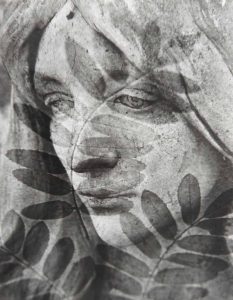
Daniel Blau Ltd. is pleased to be exhibiting at this year’s Spring Decorative Fair for the first time. We will be showcasing a specially selected collection of photographs that explore the portrayal of women throughout the history of photography. The thematic content of the photographs ranges from a large portrait of Marilyn Monroe to foot binding practices in China. The collection will interest the discerning interior decorator, as well as the avid collector of historical images.
April 20, 2012 – May 25, 2012
This April Daniel Blau Ltd. is very pleased to present a selection of images that question the role of identity and scale the vintage photographic oeuvre. Since photography’s beginning the question of representation and truth has been widely discussed, complicated by the medium’s insistence on “realism”. In a photograph grandeur is minimised, compacted, and fixed like Baltic amber pulled from the sea, ensnaring the maker’s “vision” in reduced format.
Moving along into the 20th century, photographic technology advanced to such a degree that the operator of the camera no longer even needed to be present – imagine the first view of Earth from Space encrypted in video and produced in a Californian Lab. We can think back to the origins of photography and to Daguerre with his famous dioramas – large-scale theatrical backdrops that intended to represent more closely the feeling of being pulled into a vision of the mountains and streams of ancient Greece. So what happens when we reduce the idea of optics to a singular two-dimensional object? Can we identify our place within the frame or must we also compress, reduce, and rend the photograph to fit our own scale within the universe?
We live in a new era of rapid technological advancements built upon major achievements such as the infamous atomic bomb testings in the Pacific atolls. Why should our understanding of our place within the frame not also advance?
Please join us for our opening on Thursday 19th April from 6 – 9 pm at 51 Hoxton Square, London N1 6PB.
 +49 89 29 73 42