



Author: dblauadmin
February 22, 2012 – March 3, 2012
A special preview at our Munich gallery of our exhibition in New York opening at C.G. Boerner on March 27th.
As Picasso was the central star for painting and Man Ray for modern photography, Gustave Le Gray was the prominent figure early 19th Century photographers had to conquer before they could make a name for themselves.
Like many of his colleagues, Le Gray was a painter before he enthusiastically embraced the new medium of photography. By 1849 he had entered the Paris photo scene with his calotype landscapes taken in Fontainebleau and from there found further influence teaching photography to a group of students including Du Camp, Le Secq, Mestral and Tournachon, who in turn would also go on to achieve great fame in photography.
His ground breaking inventions rapidly set new standards for size and quality. In 1857, his Vague Brisée, a “snap-shot” of a small boat with wind-filled sails and a breaking wave in the foreground, was shown to an approving and fascinated audience.
As a technical perfectionist, Le Gray was above all a great painter with the camera.
In addition to the excellent Vague Brisée three new discoveries will be shown, calotypes taken at Fontainebleau castle. Rare treasures from the estate of his colleague Le Secq, they appear to be the only surviving examples of these images.
We are thrilled to present these works to our American audience and consider our gallery very fortunate to reintroduce these pictures to the œuvre of Le Gray.
Please click here for information about our New York exhibition
March 16, 2012 — March 25, 2012
Daniel Blau is pleased to present Old Master Photographers: Photographs from the 1850’s alongside our exhibition of Andy Warhol drawings from the 1950’s. These photographers are the original masters who developed the science and the aesthetics of photography – the first to truly experiment with and push the boundaries of the medium.
Warhol’s sensual early drawings coalesce brilliantly with the images from the first decades of photography – both selections have the capacity to teach us direct lessons on what it means to create, rather than to produce, as well as portraying the genesis of artist and medium.
It’s interesting to see what has happened in the 100 years between the generation of these photographs and of Warhol’s drawings. The photograph was a revolutionary development, which caused many frustrated artists to swap their paint brushes for cameras and to utilize photography as their main artistic media.
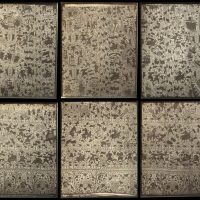
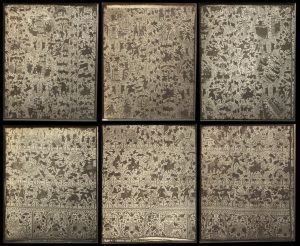
As a new discovery we’re showing a series of photographs of a tapestry taken by the Bisson brothers for the Duke of Luynes in 1855 – 6 successive photographs arranged side by side to form a large picture of about 70 x 100 cm!
March 16, 2012 — March 25, 2012
“Drawing as an exploding plastic metaphor – graphite becomes an extension of the artist’s fingers”.
Quote from the catalogue essay by Sydney Picasso.
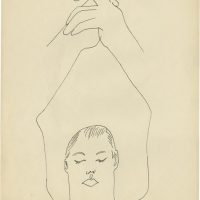
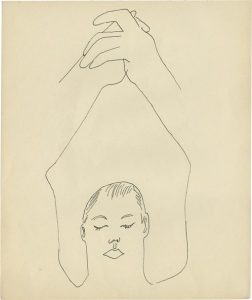
The name “Andy Warhol” brings to mind colourful silkscreens and cans of soup: glossy, finished products arranged neatly on gallery and museum walls. However, his early drawings exhibit a profound technical ability, a draftsman’s skill that reveals a lesser-known Warhol.
We will be showing a collection of extremely rare works from the 1950’s. These are Warhol’s manual experiments with mechanical reproduction and have not seen the light of day for over 50 years. His process of tracing photographs from projected images and blotting the ink onto other pieces of paper is a rudimentary form of printmaking involving multiple stages. We are excited to exhibit these moments of metamorphosis, testaments to a period of revolution in Warhol’s life and artistic career.
Whilst the drawings produced during his first years in New York were often commercial ventures, they embody the embryonic talent so apparent in his later art. These are preliminary drawings, stills from the film of artistic progress, intentional artworks in themselves. They are playfully filled with dotted lines and occasional patches of colour which contrast with the neutral dead surfaces of his subsequent work. This treasure trove from Warhol’s personal collection gives us invaluable new insight into his first ten years as an artist in New York and represents his budding genius. From kids in Central Park to gun-wielding men and a boy shooting up, these drawings are Warhol’s artistic take on the darker side of society.
TEFAF (The European Fine Art Fair)
STAND 443
MECC, 6229 GV Maastricht
The Netherlands
March 29, 2012 — April 1, 2012
This exhibition includes works by some of the greatest photographers of the first generation, such as Alinari, Baldus, Bisson, de Beaucorps, Le Secq, Marville and Nègre and others.
We have selected the pictures not only for their artistic merit but also for the condition and quality of each print. Furthermore the focus of this small selection is on the transitional years 1850-60.
This is a particularly interesting time of rapid developments in photography. The invention of the glass negative and albumen paper gave the artists important choices of “soft” or “sharp focus”, depending on the selected materials.
This difference is nicely illustrated in the two prints from the same negative by Baldus of Michaelangelo’s Slave. One is printed on salt paper and the other on albumen paper and both prints are beautiful in their own rights.
Some artists preferred the traditional paper negatives like for example de Beaucorps who in 1859/60 still used them on his extended travels in Europe and North Africa. Others like the Brothers Alinari or Bisson produced photographs of unsurpassed sharpness and clarity from glass negatives on albumen paper.
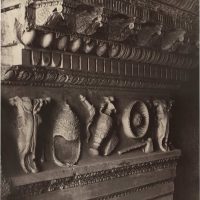
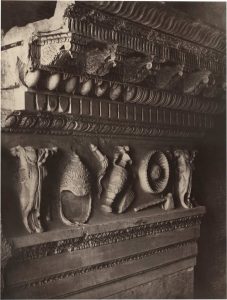
The Brothers Bisson made some of their greatest prints at this time. The large and mysterious photo of the Roman architectural detail is an outstanding example of their artistic excellence and technical achievements.
AIPAD
Park Avenue Armory
67th Street and Park Avenue
New York City
Opening: March 28, 2012, 5 – 9 pm
Exhibition: March 29 – 31, 11 – 6 pm / April 1, 11 – 5 pm
Gustave Le Gray will not be included here, as his works are being shown in our special exhibition “Thoroughly Le Gray” at the rooms of C.G. Boerner.
March 27, 2012 — April 1, 2012
A special exhibition at the rooms of C.G. Boerner in NY
As Picasso was the central star for painting and Man Ray for modern photography, Gustave Le Gray was the prominent figure early 19th Century photographers had to conquer before they could make a name for themselves.
Like many of his colleagues, Le Gray was a painter before he enthusiastically embraced the new medium of photography. By 1849 he had entered the Paris photo scene with his calotype landscapes taken in Fontainebleau and from there found further influence teaching photography to a group of students including Du Camp, Le Secq, Mestral and Tournachon, who in turn would also go on to achieve great fame in photography.
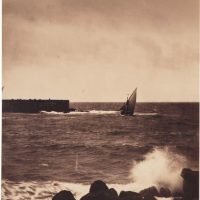
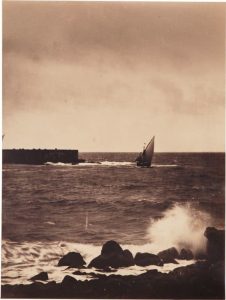
His ground breaking inventions rapidly set new standards for size and quality. In 1857, his Vague Brisée, a “snap-shot” of a small boat with wind-filled sails and a breaking wave in the foreground, was shown to an approving and fascinated audience.
As a technical perfectionist, Le Gray was above all a great painter with the camera.
In addition to the excellent Vague Brisée three new discoveries will be shown, calotypes taken at Fontainebleau castle. Rare treasures from the estate of his colleague Le Secq, they appear to be the only surviving examples of these images.
We are thrilled to present these works to our American audience and consider our gallery very fortunate to reintroduce these pictures to the œuvre of Le Gray.
Opening: March 27, 6 – 9 pm
Exhibition: March 28 – 30, 10 – 6 pm / March 31 & April 1, 11 – 5 pm
C.G. Boerner,
23 East 73 Street (3rd floor)
New York, NY 10021
+1 / 212 / 772 7330
February 17, 2012 – April 13, 2012
“If you are not willing to see more than is visible, you won’t see anything.”
Ruth Bernhard
What we see here are unique paper negatives from the 1850’s by some of the greatest old master photographers. They are the true originals, created by the light reflecting off the photographed subject. For their beauty, zeitgeist, rarity and provenance they rank amongst the greatest treasures of photography.
The paper negative had its heyday for a brief period in the early days of photography until c. 1860. Because the negative is the plate from which a multitude of positive prints can be made, it normally remained in the photographer’s possession during his lifetime. Only later would it enter into public collections by will of the photo-grapher or the family’s donation. It is rare to find negatives by famous artists such as Le Secq, Nègre, de Beaucorps or de Clercq in private hands.
A negative can be so much more evocative than a positive print. We realize from the blurred movement of the clock’s hand on the picture of the Palazzo Vecchio that it took 3 minutes of exposure time to take the photo, long enough to empty the square of all the people moving about. Their movements made them invisible to the camera. Only the building remains in its static existence with the guard’s rifles leaning against the wall.
Like a printing plate, the photographic negative has long been regarded as a stage in a working process. Surrealism and other lessons in art have taught us how to look at the more abstract pictures of the world. We have since begun to appreciate the photographic paper negative with its saturated, ominous dark against the ethereal pale as a work of art in its own mysterious beauty!
December 13, 2011 – January 31, 2012
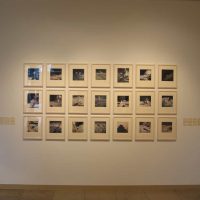
Daniel Blau is pleased to present a unique collection of rare vintage NASA photographs. These incredible pictures depict the wonder and awe of space travel.
These photographs have become part of our collective visual memory for the twentieth century; pictures that markedly symbolise the speed and power of post-war technological development at a time when Cold War tension was rife between the US and Russia. And so began the space race; the period of the 1960’s that saw the first man on the Moon. Missile technology, taken from Germany at the close of WWII, set the technological precedence for manned space crafts to orbit the Earth, eventually landing on lunar soil: a period in human history incomparable to any other; photographed, with immense beauty, for the whole world to gaze in astound.
These are not simple snap-shots by an amateur, taken with a Kodak box, but the result of the combined efforts of thousands of workers and scientists at NASA. Indeed, these are the most expensive photographs ever produced. To see these prints in the flesh is an experience as close to bouncing on lunar soil as any of us will ever get. These magnificent landscapes can be compared to Gustav Le Gray’s large prints of Fontainebleau or his seascapes. Today we treasure these vintage prints for their artistic quality and as permanent visual evidence of a time when the future seemed so close…
‘…Our first shock comes as we stop our spinning motion and swing ourselves around so as to bring the Moon into view. We have not been able to see the Moon for nearly a day now, and the change is electrifying. The Moon I have known all my life, that two-dimensional small yellow disk in the sky, has gone away somewhere, to be replaced by the most awesome sphere I have ever seen. To begin with, it is huge, completely filling our window. Second, it is three-dimensional. The belly of it bulges out toward us in such a pronounced fashion that I almost feel I can reach to touch it…’
– Michael Collins, Apollo XI, July 1969 (NASA Sp-350, 1975, p. 207)
December 13, 2011 — January 31, 2012
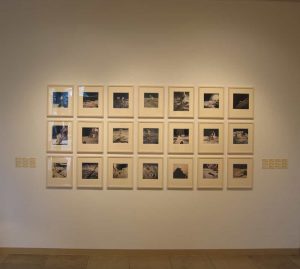
Daniel Blau is pleased to present a unique collection of rare vintage NASA photographs. These incredible pictures depict the wonder and awe of space travel.
These photographs have become part of our collective visual memory for the twentieth century; pictures that markedly symbolise the speed and power of post-war technological development at a time when Cold War tension was rife between the US and Russia. And so began the space race; the period of the 1960’s that saw the first man on the Moon. Missile technology, taken from Germany at the close of WWII, set the technological precedence for manned space crafts to orbit the Earth, eventually landing on lunar soil: a period in human history incomparable to any other; photographed, with immense beauty, for the whole world to gaze in astound.
These are not simple snap-shots by an amateur, taken with a Kodak box, but the result of the combined efforts of thousands of workers and scientists at NASA. Indeed, these are the most expensive photographs ever produced. To see these prints in the flesh is an experience as close to bouncing on lunar soil as any of us will ever get. These magnificent landscapes can be compared to Gustav Le Gray’s large prints of Fontainebleau or his seascapes. Today we treasure these vintage prints for their artistic quality and as permanent visual evidence of a time when the future seemed so close…
‘…Our first shock comes as we stop our spinning motion and swing ourselves around so as to bring the Moon into view. We have not been able to see the Moon for nearly a day now, and the change is electrifying. The Moon I have known all my life, that two-dimensional small yellow disk in the sky, has gone away somewhere, to be replaced by the most awesome sphere I have ever seen. To begin with, it is huge, completely filling our window. Second, it is three-dimensional. The belly of it bulges out toward us in such a pronounced fashion that I almost feel I can reach to touch it…’
– Michael Collins, Apollo XI, July 1969 (NASA Sp-350, 1975, p. 207)
December 14, 2011 – December 22, 2011, 2012
Please join us for a rummage through a collection of enigmatic and vernacular photographs put together over the span of 13 years. From wall to table, all photographs, at your perusal, will be available for sale from 80 English pounds upwards. For this special Christmas event we have extended the gallery hours to include Sunday the 18th December, 11am to 6pm.
November 3, 2011 — November 30, 2011
“He was not to do anything of bad taste, the women of the inn warned old Eguchi. He was not to put his finger into the mouth of the sleeping girl, or try anything of that sort” – ‘House of the Sleeping Beauties’ by Yasunari Kawabata.
Daniel Blau, London/Munich, in collaboration with Galerie Meyer, Paris, is pleased to present an exhibition of Nobuyoshi Araki polaroids.This exhibition will take place in the cultural quarter of Saint-Germain-des-Prés, to coincide with the photography festival in November.The quarter is infamous for the French home of existentialist literature – the creative birthplace of prominent writers including Jean-Paul Satre and Simone de Beauvoir.With this in mind, and in ode to the relationship between photography and literature, we have decided to engage directly with literary themes, by presenting to you a series of frozen narrative moments in photography: Araki’s polaroids.
In the introduction toYasunari Kawabata’s House of the Sleeping Beauties,Yukio Mishima compares Kawabata’s writing to a photograph. He says, like a still image, Kawabata’s writing might expose the light-world in which we live, revealing its bright, plastic hypocrisy. Literature is compared to the photographic image; both freezing moments in narrative time. Like Kawabata, Araki developed a profound frustration for the conservativism of Japanese society’s attitude to sex, and like Kawabata’s House of the Sleeping Beauties, Araki’s photographs seek to radicalise and re-invent the way we view nudity and sexual implicitness in Japanese culture, alongside the boom of the sex industry in Japan in the 1970s, 80s and 90s.
With true beauty and precision, it is Araki who brings this idea to life in the image; his series of polaroids conjuring a Kawabata-like story; where nude women become the beautiful protagonists in the perfect eroto-pornographic tale.
 +49 89 29 73 42