



Author: dblauadmin
November 10, 2011 — November 13, 2011
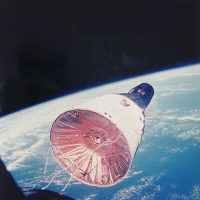
Daniel Blau is pleased to present a unique collection of rare vintage NASA photographs. These incredible pictures depict the wonder and awe of space travel.
These photographs have become part of our collective visual memory for the twentieth century; pictures that markedly symbolise the speed and power of post-war technological development at a time when Cold War tension was rife between the US and Russia. And so began the space race; the period of the 1960’s that saw the first man on the Moon. Missile technology, taken from Germany at the close of WWII, set the technological precedence for manned space crafts to orbit the Earth, eventually landing on lunar soil: a period in human history incomparable to any other; photographed, with immense beauty, for the whole world to gaze in astound.
These are not simple snap-shots by an amateur, taken with a Kodak box, but the result of the combined efforts of thousands of workers and scientists at NASA. Indeed, these are the most expensive photographs ever produced. To see these prints in the flesh is an experience as close to bouncing on lunar soil as any of us will ever get. These magnificent landscapes can be compared to Gustav Le Gray’s large prints of Fontainebleau or his seascapes. Today we treasure these vintage prints for their artistic quality and as permanent visual evidence of a time when the future seemed so close…
‘…Our first shock comes as we stop our spinning motion and swing ourselves around so as to bring the Moon into view. We have not been able to see the Moon for nearly a day now, and the change is electrifying. The Moon I have known all my life, that two-dimensional small yellow disk in the sky, has gone away somewhere, to be replaced by the most awesome sphere I have ever seen. To begin with, it is huge, completely filling our window. Second, it is three-dimensional. The belly of it bulges out toward us in such a pronounced fashion that I almost feel I can reach to touch it…’
– Michael Collins, Apollo XI, July 1969 (NASA Sp-350, 1975, p. 207)
Paris Photo, 10 – 13 Nov 2011
Grand Palais, Avenue Winston Churchill, 75008 Paris
A newspaper catalogue will accompany the exhibition.
October 11, 2011 – December 12, 2011, 2012
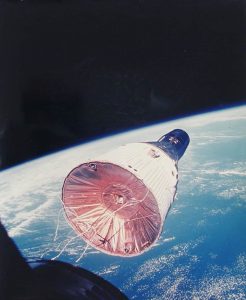
On the occasion of Gerhard Richter’s major retrospective at the Tate Modern this October, Daniel Blau Ltd. will be housing a parallel exhibition entitled “Benjamin Katz: Gerhard Richter – Atlas Exchanged”.The result of a friendship spanning more than four decades between Richter and Katz, this selection of 80 photographs is taken from the photographer’s vintage archive and includes portraits taken from the 1980s onwards at a variety of locations, including Richter in his studio.
Not confined to the canvas, Richter’s dialogue with photography, prints, and other media present an unequivocal insight into the post-war artist finding his subject matter through whichever media is at hand. The importance of Richter’s body of work “Atlas” is now well documented; serving to highlight the artist’s life’s work and processes through a spiraling amalgamation of imagery culled from his archive. In direct relation to this, we present Katz’s consistent documentation of the spirit of Richter living amongst his work: Katz fashions his photographs in such a way as not to intrude, but, rather to be part of an exchange of ideas found deep within Richter’s sprawling oeuvre.
October 21, 2011 – December 23, 2011
During the Kunstwochenende (Munich Art Weekend) Daniel Blau will be showing the works of British artist Rachel Kneebone. In her first solo show in Germany, Kneebone will exhibit a group of finely detailed porcelain sculptures. These objects grapple with themes of sexuality and death, drawing the viewer into a dark yet humorous world. Taking influence from such things as Dante’s Divine Comedy, William Blake’s The Primaeval Giants Sunk in the Soil (1824–1827) and Ovid’s Metamorphosis, these often phallic, grotesque yet enigmatic sculptures are riddled with a shiny, contorted tale of beauty at its point closest to sex and death.
Kneebone was born in 1973 in Oxfordshire and graduated from the renowned Royal College of Art in London in 2004. In 2005 she was nominated for the MaxMara Art Prize for Women, and that same year, Mario Testino invited her to create a wall sculpture for his show, Diana, Princess of Wales, at Kensington Palace. In 2010 she was awarded the audience prize at the 11th Sculpture Triennial in Felbach. Kneebone lives and works in London.
September 15, 2011 — September 18, 2011
186.283 mps
An exhibition of rare NASA photographs 1965 –1981.
Two great achievements in science have given us some of the most striking and memorable photographic images of the 20th century. The iconic pictures of the rising mushroom cloud were a visual testimony to the success of atomic tests. Space exploration gave us unforget-table views of Earth and Moon as seen from space (Apollo 8), as well as “Buzz” Aldrin’s footprint in Lunar soil. These pictures have become part of our visual memory. They are not simple snap-shots by an amateur, taken with a Kodak Box, but the result of the combined efforts of tens-of-thousands of workers and scientists.Some of these astronomically costly missions, Luna 3 for example, produced very few useful photographs, making each print absurdly expensive and ultimatly precious. These grainy pictures of the Moon from afar are strangely remeniscent of the Shroud of Turin and induce the same sense of wonder. Other missions resulted in an endless stream of photographs both in color and black and white, in negative and positive (Apollo XI). From 1945 through the early 1960’s the USA “flooded” the world’s press agencies with thousands of images of atomic tests. They were photographed in every possible way, keeping the audience continuously in awe; from the ground, from the air, under water, through a periscope, next to a zeppelin, at night, during the day or even “by invitation only.” As the Space Race became more of the public and media focus, photographs taken in space replaced the explosion pictures. Now it was the blast-off, the blue Earth, two space ships meeting in the void above Earth (Gemini), photos radioed back from rockets moments before impacting the Lunar surface (Ranger), pictures taken by radio controlled video cameras on the Moon, radioed back to Earth and reassembled here (Surveyor). One of the unmanned missions (Orbiter) asked for a complete dark room to be shot into space. It was a kind of photo-booth taking photos of the moon while orbiting it, developing the film, scanning the negative and radioing the data back to Earth. Here the signal was again transferred onto negative film from which the positive pictures were printed. The Orbiter probe eventually crashed on the Moon, thus destroying the original negatives. The successful landing of Apollo XI on the Moon changed all that; from July 1969 on we became used to focused and detailed photographs in colour. True, the pictures we received while the astronauts were still “out there” had the low quality of wire-prints. On the other hand, the Kodak films they brought back were crisp and “juicy” like tourist photos from Rome, the Grand Canyon or Palm Springs. The images of the atomic cloud, as well as those of the astronauts on the Moon were “tools” of propaganda for the American dream, demonstrating might and offering hope. In San Francisco at SF20/21, we are presenting a selection of significant vintage NASA photographs. Some of them are unique surviving examples of the Sisyphean task of assembling thousands of small photographs to fairly large mosaics of Moon-scapes (Surveyor). Others are important for their size or simply as rare survivors from a once important archive of prints that, within the last fifty years was dispersed, perhaps on account of digitisation or because it became technologically antiquated. Today we treasure these vintage prints for their artistic quality and as permanent visual evidence of a time when the future seemed so close.
Opening: September 15
Exhibition: September 16 –18, 2011
Festival Pavilion at Fort Mason Center San Francisco, CA 94123
Telephone at the booth: +49 / 172 / 74 84 999
September 1, 2011 – October 6, 2011
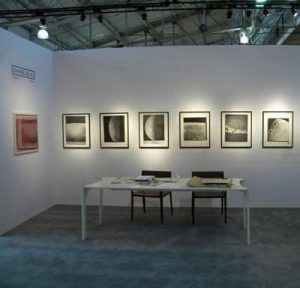
An exhibition of vintage, anonymous, vernacular and spirit photography, also including works by Fratelli Alinari, Cecil Beaton, René Barthélemy, Paul Berthier, Emil Cadoo, Louis Joseph Deflube, Arthur Conan Doyle, JH Engstrom, Walker Evans, Jean-Baptiste Frenet, Michael Grieve, Bill Jacobsen, Fritz Lang, Rut Blees Luxemburg, Charles Marville, Tina Modotti, Floris Neusüss, Arnold Newman, Diane Pernet, Leni Riefenstahl, Henri Sauvaire, Jeffrey Silverthorne, Edmund Teske, U.S. Army Picture Corps, Louis Vignes et al.
“They are moving because of their phantom condition; every act they execute may be their last; there is not a face that is not on the verge of dissolving like a face in a dream.”
Jorge Luis Borges
We are pleased to present a unique set of images that embody a theme particularly relevant to current artistic and cultural practice: that of the haunted, the blurred and the dissolved. To exemplify these themes this exhibition will feature vintage prints as well as more recent explorations in photography and its often-dissolute processes. In homage to the alchemy and chemistry of photography, this show will illustrate fire, smoke, the spirit, the x-ray, blur and motion, decay and the photogram. Like a series of dark objects and entities trapped behind the framing of glass, the gallery space becomes a chapel to the haunted history of the photographic medium.
Christa Dichgans was born 1940 in Berlin. She studied from 1960-65 at the Berlin Academy of Arts under Fred Thieler and worked as Georg Baselitz’s assistant from 1984 to 1988. She lived and worked in Berlin and La Haute Carpénée in Southern France.
Exhibitions and Distinctions (Selection)
2019
Galerie Daniel Blau, Munich
2014
Galerie Daniel Blau, Munich
2010
Galerie Daniel Blau, Munich
2006
Galerie Contemporary Fine Arts, Berlin
1997
Galerie Daniel Blau, Munich
1996
Artist group “Die Ecke”, Augsburg
1995-2000
Journeys through Russia and Asia
1995
Museé d’Art Moderne, Nice
Goethe Institut, Moscow
1985
Mannheim Art Association. Municipal Gallery Viesen
1981
Göttingen Art Association
1978-1979
82 etchings for the book “was – wenn/ was nicht/ wenn nicht”, published and commentated by “Y” (A.R. Penck), Galerie Springer, Berlin
1977
Galerie Springer, Berlin
1975
Lerner-Heller Gallery, New York
1974
Galerie Marzona, Bielefeld
1972
Galerie Springer, Berlin
1971
Residence at Villa Romana, Florence
1966-1967
DAAD scholarship in New York
1964-1967
German National Scholarship
Literature (Selection)
Christa Dichgans – Spielzeugbilder, Galerie Daniel Blau, Munich 2010
Christa Dichgans – King Kong Kisses, Contemporary Fine Arts, Berlin 2006
Christa Dichgans – Werke 1969 – 1998, Bern Berlin 2000
Christa Dichgans – Retrospektive, Städtische Galerie Viersen 1995
Christa Dichgans – Werke 1964 – 1991, ed. by Haus am Waldsee, Berlin 1992
Christa Dichgans – Bilder 1967-1972, Galerie Springer, Berlin 1972
July 7, 2011 – August 10, 2011
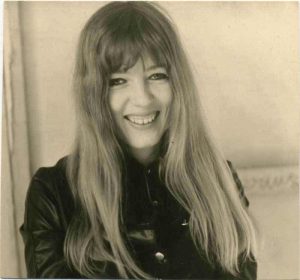
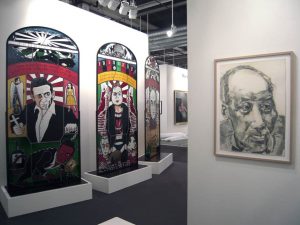
Daniel Blau Ltd. is pleased to present Neal Fox’s latest project Beware of the God. Fox’s drawings depict a phantasmagoric journey through the detritus and mythology of pop culture. From a life-long obsession with the tales of his dead grandfather, a World War II bomber pilot, writer and hell raiser, his large-scale drawings have developed into increasingly layered celebrations of the debauched and iconoclastic characters whose ideas have helped shape our collective consciousness.
Fox’s latest project takes many of the recurring subjects of his drawings and portrays them through the medium of the stained glass window. As traditional church windows show the iconography of saints, through representations of events in their lives, instruments of martyrdom and iconic motifs, Fox plays with the symbolism of each character’s cult of personality; Albert Hoffman takes a psychedelic bicycle ride above the LSD molecule, J G Ballard dissects the world, surrounded by 20th Century imagery and the eroticism of the car crash, and Johnny Cash holds his inner demon in chains after a religious experience in Nickerjack cave. One quality in particular binds these characters and the others together; a refusal to conform and conviction in their own ideology.
Working with traditional methods at the renowned Franz Mayer of Munich manufacturer, Fox is producing a set of twelve 2.5 metre high stained-glass windows; exhibited in a single room – an alternative church of alternative saints.
June 15, 2011 — June 19, 2011
Galerie Daniel Blau is pleased to be exhibiting at Art Basel 2011, 15 – 19 June, 2011. www.artbasel.com
Art Basel takes place in Halls 1 and 2 of Messe Basel, Messeplatz, 4005 Basel, Switzerland. You can view our stand on the ground floor, booth D8.
–
We will be exhibiting works by:
Georg Baselitz
Glen Baxter
Chris Bianchi
Bill Bragg
Jake and Dinos Chapman
Leigh Fox
Neal Fox
Lucian Freud
Adam Fuss
Anselm Kiefer
Rachel Kneebone
Matt Mullican
Stephanie von Reiswitz
Robert Rubbish
Andy Warhol
June 9, 2011 – October 14, 2011
Parallel to his retrospective at Haus der Kunst, Munich, the American artist Matt Mullican will be showing at Galerie Daniel Blau.
The works of Mullican, born in 1951 in Santa Monica, California, hang in the most important collections and museums around the world; among them the Museum of Modern Art; the Whitney Museum, New York; LACMA, Los Angeles; Centre Pompidou, Paris; the Museum Ludwig, Cologne and the Tate Modern, London.
We will be showing a selection of pieces created between 1970 and 2011, taken from previous gallery exhibitions Mullican has had over the years with Daniel Blau. Central to this exhibition will be five large stained-glass windows, made by the artist at the Mayer’sche Hofkunstanstalt in Munich in 2010 and shown here for the first time.
Eugène Leroy (1919-2000) was introduced to the Dutch Old Masters Rembrandt and Jordaens as a teenager, and later to El Greco and Goya. From 1931 to 1932 he studied at the École des Beaux‑Arts in Lille and Paris, but he quickly decided that the methods and approaches of the academies did not correspond with his understanding of art. He moved to Roubaix, where he worked as a Latin and Greek teacher. He consistently pursued his painting during this time. In 1936 he saw “The Jewish Bride” by Rembrandt in the Amsterdam Rijksmuseum and the abstraction of materiality and the flesh were to fascinate him throughout his life. He had his first exhibition in Lille in 1937. He continued to teach during World War II. His post-war works are characterized by dark colors and have a strong connection to the North Sea. This style of painting was thematically interrupted by a crucifixion scene that he created for a chapel in Roubaix in 1946-48. In 1954 he exhibited with Sam Francis, Serge Poliakoff and Marcel Pouget. His first solo exhibition took place at the Tourcoing Museum in Dunkirk in 1956. Leroy’s move to Wasquehal in 1958 is clearly evident in his œuvre, as there is a noticeable shift in his compositions towards more abstraction. From 1955-70 he exhibited in the May Salon in Paris. Numerous exhibitions followed, and the 1988 retrospective in the Musée d’Art Moderne de la Ville de Paris deserves special mention. In 1992 he took part in the documenta IX in Kassel and in 1995 in the Venice Biennale.
Leroy died 2000 in Wasquehal.
Exhibitions and Distinctions (Selection)
2022
Hall Art Fondation, Kunstmuseum Schloss Derneburg, Holle, Germany
2021
MUBA, Tourcoing, France
2009
Donation of 600 works to the Musée des Beaux-Arts de Tourcoing
2004
Musée d’Art et d’Industrie, La Piscine, Roubaix
2001
Musée d’Art Moderne, Villeneuve d’Ascq
2000
Art Association for Rhineland and Westphalia, Dusseldorf.
Albright-Knox Art Gallery, Buffalo (NY)
1997
Kunsthalle Basel
1996/97
Retrospective at Centre díArt Contemporain Bignan, Centre díArt Contemporain Rennes and Musée des Beaux-Arts de Rennes
1996
Grand Prix National de la Peinture
1995
45th Venice Biennale
1994
Galerie Daniel Blau, München
1993
Musée d’Art Moderne et d’Art Contemporain, Nice
1992
Documenta IX, Kassel
1991
Participation at 21st Sao Paolo Biennale
1987
Musée d’Art Moderne, Villeneuve d’Ascq
1988
Stedelijk Van Abbemuseum, Eindhoven
Musée d’Art Moderne de La Ville de Paris
1982
Museum van Hedendaagse Kunst, Gent
1977
Ecole des Beaux-Arts, Lille
1970
Wiener Sezession, Wien
1960-65
Collaboration with Claude Bernard Gallery, Paris
1957
Prix Emile-Othon Friesz
1956
Musée des Beaux-Arts, Tourcoing
Literature (Selection)
Eugène Leroy – Alles ist Farbe, ed. by Kunstverein für die Rheinlande und Westfalen, Dusseldorf, 2000
Bernard Marcadé, Eugène Leroy, Paris, 1999
Eugène Leroy – Peintures, ed. by Kunsthalle Basel, 1997
Hector Obalk, Eugène Leroy – Oil Paintings, Tokyo 1991
Eugène Leroy – Bilder und Zeichnungen, ed. by Galerie Daniel Blau, Munich, 1994
 +49 89 29 73 42